
The excavations of the small bathhouse at the Roman town of Cosa (Ansedonia, Italy) will recommence this summer (June 2024). The Roman colony of Cosa was established in 273 BCE, though it struggled to maintain a consistent population and status throughout its history. Recent and future excavations at Cosa aim to clarify the narrative of the town’s longue durée and rectify previously held notions about its foundation and evolution.
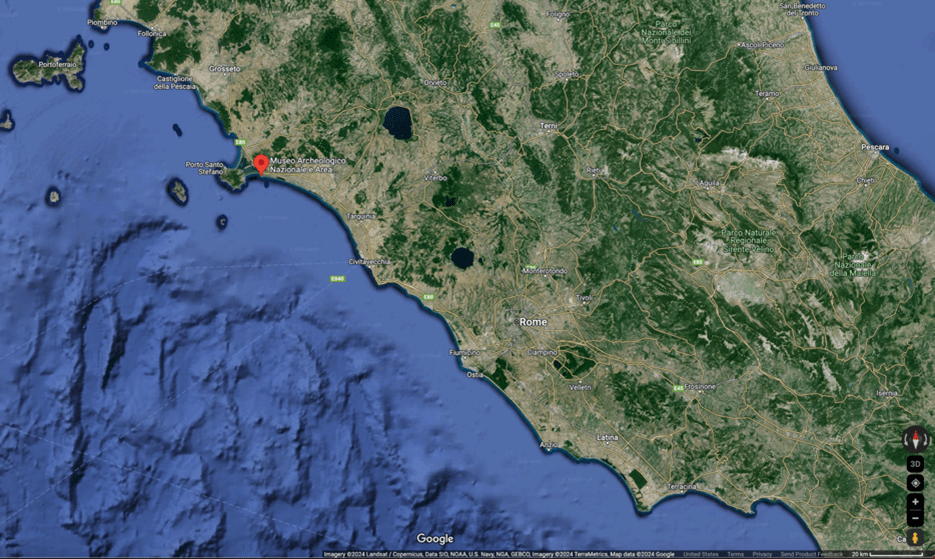
Excavations on the bath began in 2013 under the direction of Dr. Andrea De Giorgi (Florida State University) and Dr. Russell T. Scott (Bryn Mawr College). The international excavation team is made up of faculty, graduate students, and undergraduate students from a variety of institutions. This year marks what is likely the final season in this area of the town, though excavations in other portions of Cosa are in their initial stages.
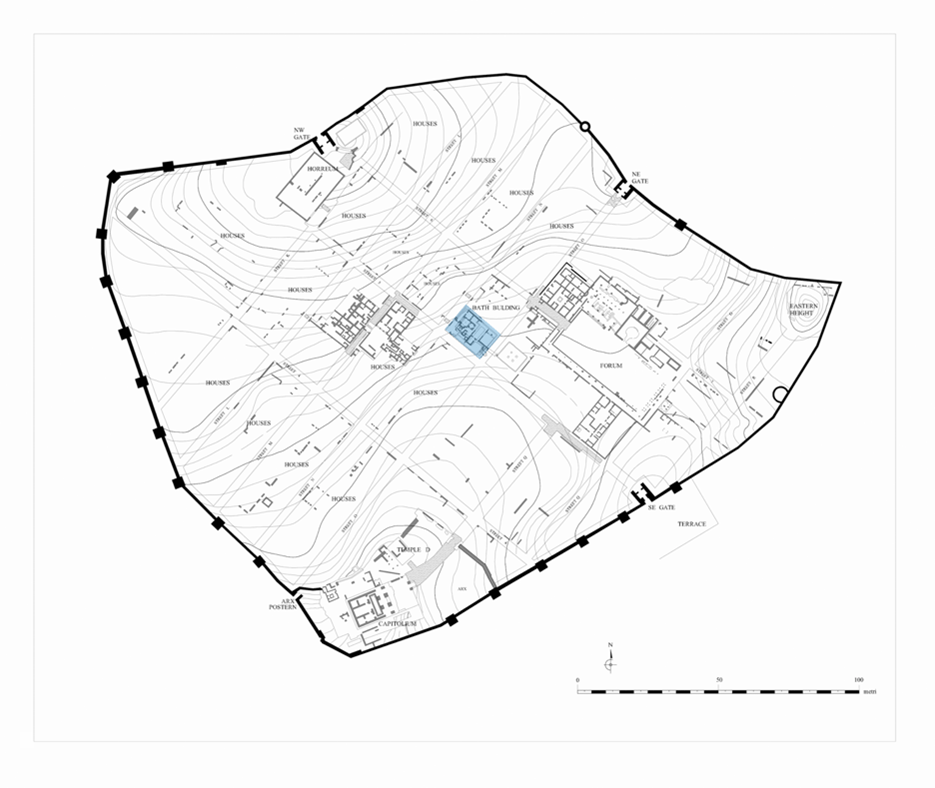
Cosa’s small public bath, located near the town’s forum, was constructed in the mid to late second century CE and features the standard sequence of rooms. Since 2013, an apodyterium, frigidarium with piscina, tepidarium, two caldaria, and a circular sweat room have been excavated. The apodyterium, the changing room of the bath, was excavated in 2013, 2014, and 2019. An opus signinum-covered bench was discovered along its eastern and southern walls.
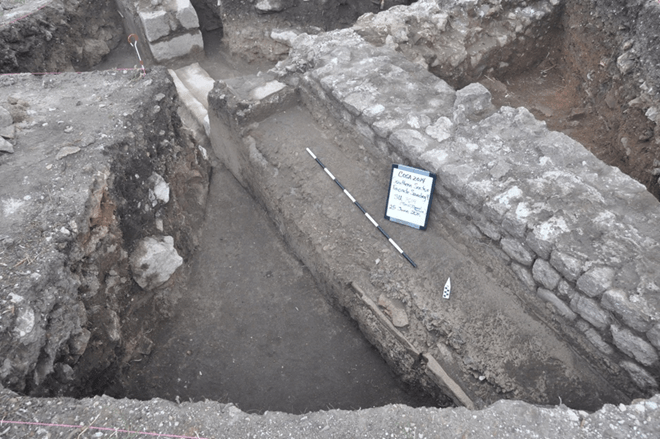
The frigidarium of the complex features a small piscina uncovered in the 2023 season. From the frigidarium, there is access to the heated rooms of the bath complex – a circular sweat room, a transitory space (likely the tepidarium), and two hot rooms (caldaria). In one of the two caldaria, an apsidal heated pool was found on the western end of a rectangular room (c. 4.5 m x 4.2 m). The second heated room does not appear to have been equipped with a heated pool, and the space is slightly smaller in size (c. 4.3 m x 4.2 m).
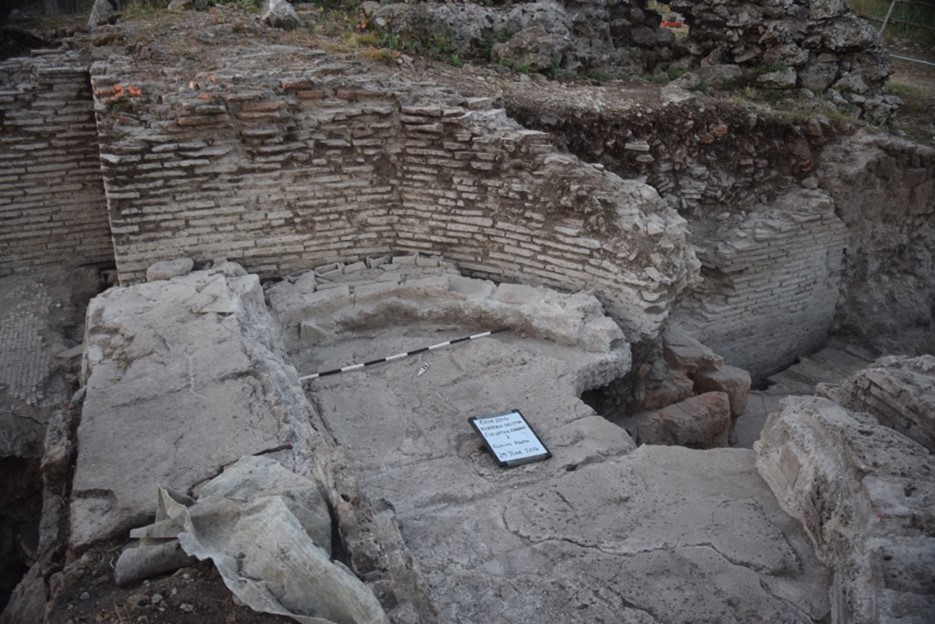
Frank Brown identified the circular sweat room as potentially belonging to a bathhouse in the initial excavations at Cosa in the 1940s under the auspices of the American Academy in Rome. Large pieces of fallen vaulting that once domed this circular room were removed in 2013 to expose this heated space. Little of the hypocaust system remains, given the force of the dome’s collapse.
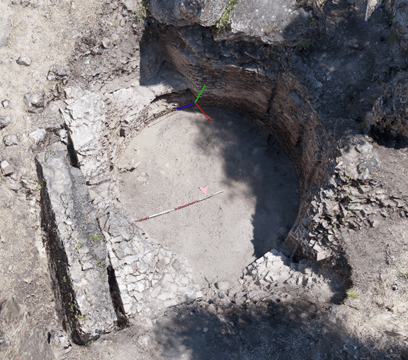
The bathing rooms are thus quite well known after the past decade of excavation, though olive trees that pepper the site’s landscape prohibit thorough investigation in certain areas. As the exploration of the bath comes to a close, the 2024 excavation season will focus on the perimeter of the building and the service areas of the bathhouse.
Visitor Information
The site of Cosa is open to the public.
Hours (April-October 2024): Tuesday-Sunday, 9:45 am–6:45 pm (closed to the public on Mondays).
The park is accessible with a free ticket available at the museum. The small museum at the site is also accessible with a purchased ticket (2€). Excavations of the baths are viewable during the month of June and are located just a short walk up the hill from the museum.
Archaeological Park of Cosa (Ministero della Cultura website)
Arriving at site: The site is not located on a train line. The closest train stations are Orbetello-Monte Argentario (6 km to the north) and Capalbio Scalo (9.5 km to the south). A car or other mode of transportation is necessary to reach the site (it is not recommended to walk from either of these train stations).
Allison Smith, Indiana University Bloomington (aes19@iu.edu or allison.smith1912@gmail.com)
 BATH – BAlnea & THermae
Leave a comment