
Hardly any other ancient site contains as many bath buildings as the Parco Archeologico di Ostia Antica. In the harbour of Rome, there exist baths of all shapes and sizes dating all along the Imperial and Late Antique periods. They range from small, unassuming examples like the Terme Piccole (I, XIX, 5) and medium-sized neighbourhood baths like the Baths of the Seven Sages (III, X, 2) all the way up to lavish complexes with connections to Imperial circles like the Forum Baths (I, XII, 6). Many of the over thirty baths of Ostia, however, have only been studied partially or superficially so far.
A doctoral research project at the Freie Universität of Berlin is now aiming to close a part of this gap by examining in detail the Invidiosus Baths in the city centre. I have begun this work as a PhD candidate in 2022 with the support of the Einstein Center Chronoi and the Berlin Graduate School of Ancient Studies. The dissertation, under the supervision of Prof. Monika Trümper and Prof. Ortwin Dally, is due to finish at the end of 2024.
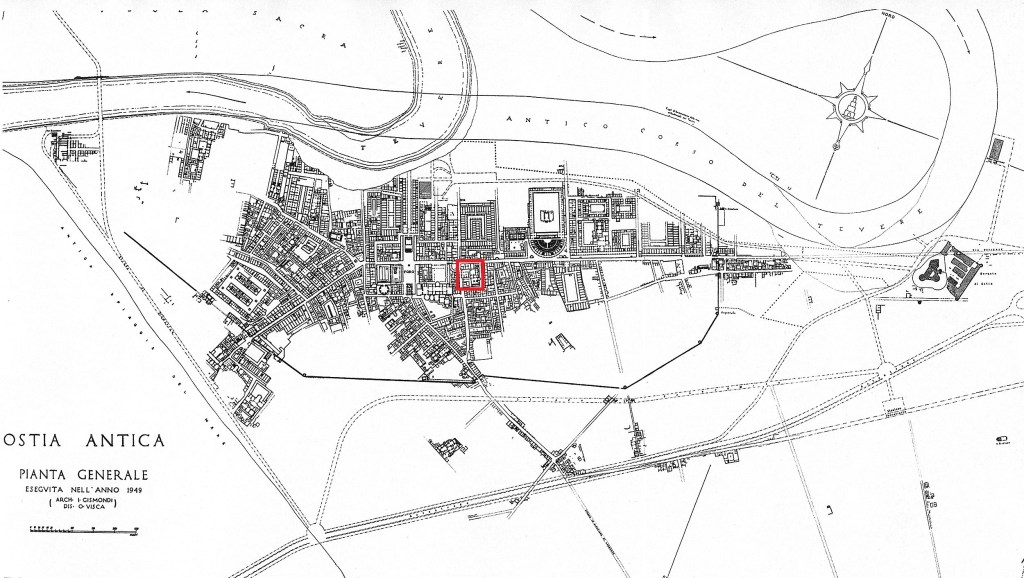
The Invidiosus Baths are situated in insula V of region V at Ostia, on the intersection of the Decumanus Maximus and the Semita dei Cippi, two of the main traffic arteries of the city. They lay just outside the eastern gate of Ostia’s Mid-Republican fortifications, the Castrum, and are only a short walking distance from the forum.
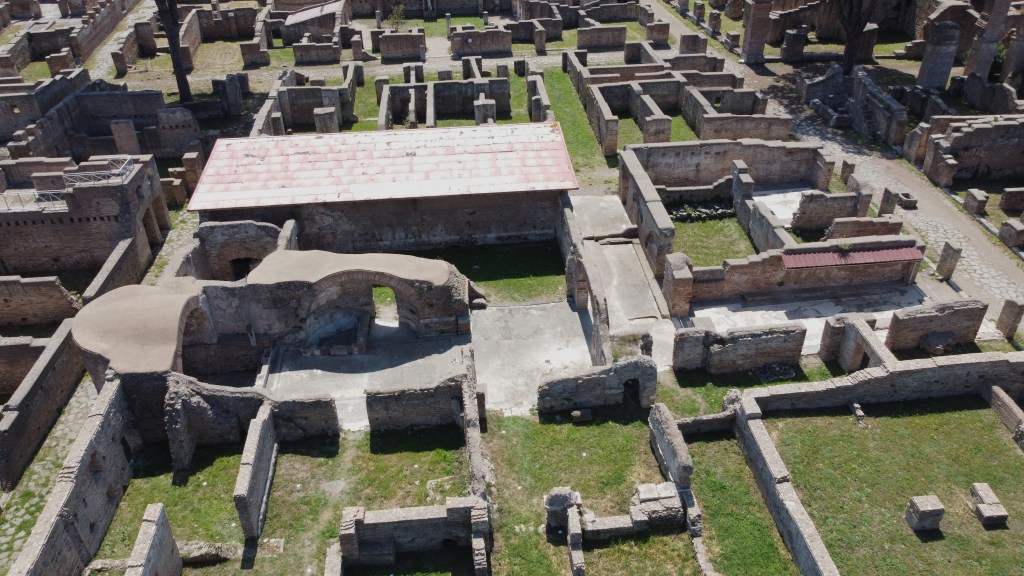
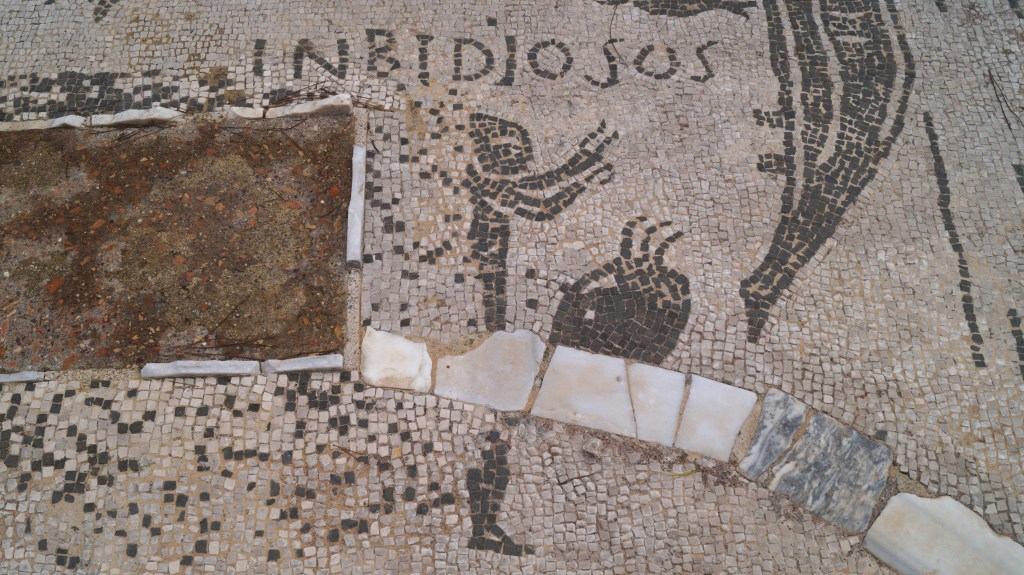
With this central and prominent position, it is perhaps no surprise that the Invidiosus Baths are among the oldest known bath buildings of Ostia, their first phase hailing from the Julio-Claudian period. Most of the remains visible today stem from a comprehensive 2nd-century rebuilding of the entire insula, which besides the baths also includes workshops and commercial spaces. In one of the latter, the eponymous mosaic of the entire complex was found: a scene of fish and fishermen, one of whom is named INBIDIOSOS by inscription. Like most mosaics in the insula, this is a work of Severan date. Building activity in the Invidiosus Baths also took place in Late Antiquity, when apses were added to some bathing rooms and the size and distribution of the water basins was changed.
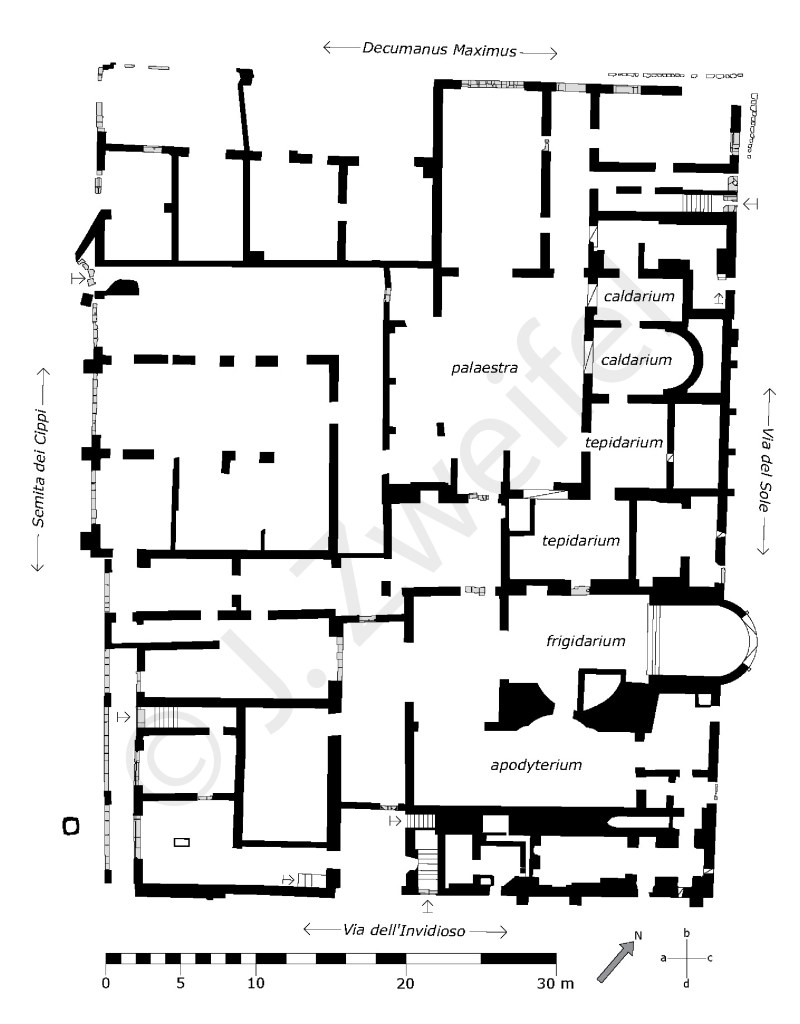
The sequence of bathing rooms in the Invidiosus Baths develops along the eastern flank of the complex from south to north. First, visitors entered the apodyterium to change and leave their clothes, before entering the frigidarium, the largest of the bathing halls. Going further north, two tepidaria followed, before the sequence terminated with two heated rooms that probably served as caldaria. A large central courtyard in the insula might have functioned as the palaestra of the baths. The remaining space of the Invidiosus Baths is taken up by waiting rooms, corridors, service rooms, shops and bars.
The aim of the dissertation project is to gain more precise knowledge about the chronology and functioning of this bath building. As a holistic microstudy, it looks at the building in terms of architecture, technical installations like heating and water-lifting devices, decoration such as mosaics, paintings and statues, and in terms of how visitors moved in the baths and experienced them. The urban context of the baths naturally plays an important role as well. All of these aspects will be examined across all of the building’s phases of use. To this end, archaeological fieldwork has been carried out to gather data. A new ground plan, photographs, descriptions and drawings will provide an updated, comprehensive basis and reference for research on these baths.

Preliminary results promise to reshape our understanding of the Indiviosus Baths. For the first time, the reconstructed ground plan of the first, original phase of the baths will be drawn and published. The definition of the subsequent building phases as sketched out in previous mentions of the Invidiosus Baths will see a great deal of refining and readjustment due to the data gathered in the field. For the first time, the afterlife of this area at the end of Antiquity and at the beginning of the Middle Ages will be studied systematically. Further results include a complete re-examination of the baths’ installations for the provision of water, insights into the work processes on the construction site, and much more. These new observations are far more than isolated new pieces of information on a single building. They can help us to gain a better understanding of the Ostian bathing landscape altogether, and hopefully they will encourage similar in-depth studies about those bath complexes in the city that remain insufficiently understood. More thorough, detailed investigations of several Ostian baths are long overdue, and the study of the Invidiosus Baths aims to inspire future research of this kind.
Jonas Zweifel, Freie Universität Berlin
jonas.zweifel@fu-berlin.de
Profile on the Berlin Graduate School of Ancient Studies webpage:
https://www.berliner-antike-kolleg.org/bergsas/promovierende/laa/jonas_zweifel/index.html
Parco Archeologico di Ostia Antica:
Viale dei Romagnoli 717, 00119 Roma, RM, Italy
Opening hours (summer months): Tuesday to Sunday, 8:30 to 18:00
https://www.ostiaantica.beniculturali.it/
To quote this page
Zweifel J. (2024), A Long Overdue Exploration: The Invidiosus Baths in Ostia, consulted on INSERT DATE, <https://ancientbaths.com/2024/08/02/zweifel-invidiosus-ostia/>
 BATH – BAlnea & THermae
Leave a comment