
The following text is a summary of the author’s MA thesis presented at the University of Bologna in 2023.
In my Master’s thesis, the result of a double degree course between the University of Bologna and the University Paris Cité, I dealt with the social role of the Roman baths. In particular, I considered the economic and environmental aspects of baths between Rome and the provinces of Gaul and Africa; the time period of this research focuses on the first two centuries of the imperial period, with the occasional foray in the Republican and late antique periods.
Inscribing my research in the discipline of the Social History of the Ancient World, I investigated the social role of Roman baths, understood here as a place of congregation where social relations and exchanges could develop. Indeed, the baths were one of those public places that characterised Roman cities; it could be argued that they were much more important than other such places, as they were experienced on a daily basis. The use of public baths in Rome spread from the 3rd century BC onwards, progressively replacing home ablutions for all social classes. Before, bathing had been an entirely private affair and, judging from the sources, not at all a daily occurrence. From this point onwards, it became a daily habit for the vast majority of the population.
Thus, Roman baths were not only places where body cleansing for hygienic reasons took place. In fact, a variety of activities could be carried out in the baths, and investigating these allows us to learn more about Roman culture. Furthermore, from the analysis of these activities, it is possible to investigate the relationships between the different social classes; in this sense, I placed a focus on gender differences between men and women, and status differences between rich and poor, but especially between freed and non-freed, Romans citizens and slaves. I also analysed the differences between the baths in Rome—focusing especially on the majestic imperial baths—and the smaller baths in the provinces of Gaul and Africa, since there too, understanding the differences offers an additional means to understand differences in the ways the citizens of Rome and those of the rest of the Empire lived. An attempt was made to understand the cost for the construction of a bathhouse, based on the consultation of primary sources and modern literature. Subsequently, I tried to understand whether the use of resources for baths already had a negative impact on the environment in the ancient world.
This dissertation also reconstructed the role of baths within Roman culture. Firstly, the architectural aspects were identified and then what went on within the different rooms. The social relations that existed between the different sexes and, above all, between those who enjoyed full citizenship versus slaves were explored in depth. Secondly, a comparison was made between Rome and its imperial baths, and the provinces of Gaul and Africa, with some examples of small bathing establishments there. In addition, research was carried out on the economic aspects inherent to bathhouses, focusing on the consumption of fuel and water resources. This was followed by further research to understand the relationship between the Romans and the environment.

Through the analysis of sources and reconstructions by modern scholars, it was possible to delve deeper into the topic and debunk certain ideas, such as the one that sees bathhouses as a peculiar place where social levelling existed, thus furthering our understanding of the type of social interactions that took place within bathhouses.
In the first part of the dissertation, I focused on the archaeological aspects, underlining how Roman baths emulated the Greek baths, but with substantial cultural and architectural differences. In Rome, going to the baths was a pleasure, a way of resting the body after the exertions of daily work. Moreover, much more than in Greece, they were places where one could heal body and mind. This is attested by rooms such as libraries and the various mentions in literary sources. By comparing the immense imperial bathhouses with the small provincial bathhouses of Glanum, Lutetia Parisiorum (Paris) and Bulla Regia, it has been deduced that the citizens of the Urbs enjoyed greater privileges, but that all in all, in every part of the empire, citizens enjoyed the pleasure and activities they could perform within the bathhouses.
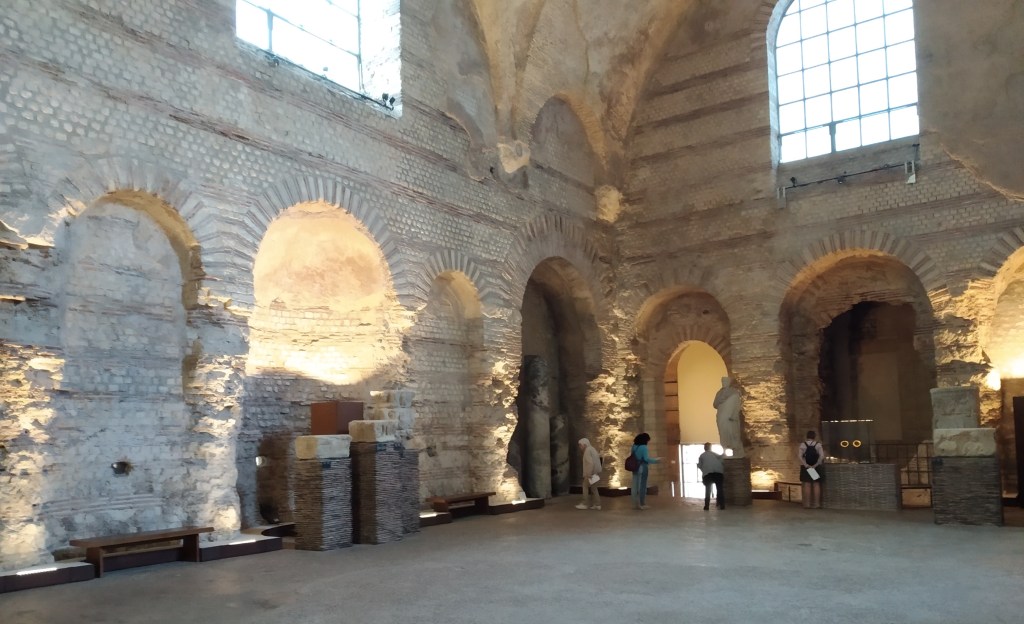
Connected to the discourse on the privileges of the citizens of the Urbs is the phenomenon of euergetism, discussed in chapter two. Through the analysis of the inscriptions, it was understood that the emperor acted as a benefactor in places where he exercised his power the most, such as in Rome. A similar discourse applies to the rest of Italy, much more closely connected with Rome by its history, whereas in the rest of the empire, it were the richest men who were in charge of financing the baths, often to bring prestige to their family or to gain esteem in view of elections. In these places, interventions by emperors only took place in the event of serious calamities, and thus formed part of the support the princeps gave to the stricken population, or for personal reasons.
Afterwards, I investigated the management of bathhouses and its staff, including the legal status of the workers themselves. An analysis of literary and legal sources showed that the situation must have been quite heterogeneous, but, in general, it can be said that the most menial jobs were performed by slaves, while the management of the facilities, or at least the administrative part, was often carried out by freedmen or cives.
At this point I focused on the social relations between the different sexes and classes. The starting point is the hypothesis that the baths were a place of social levelling, that is, a place where class differences blurred, if not disappeared altogether. Although it is undeniable that a mixing of people from different social classes took place, Garrett Fagan (1999) has shown that this was not actually true for the emperors. In fact, from a careful analysis of the sources, it is clear that emperors only went to the baths on certain occasions and were probably separated from the rest of the clientele. It is a different matter with regard to the wealthier citizens, for the sources are very clear in this case, but it is also evident from them that the less affluent had attitudes of deference towards the wealthier, so that to imagine the baths as a place where hierarchies fell away is very unrealistic.
Another particularly interesting question concerns the presence of women in the baths—having ascertained from the sources that all women from all walks of life frequented the baths—a doubt arose concerning mixed baths. Roy Bowen Ward (1992) has shown that in the passage in the Historia Augusta on the life of Hadrian in which it is stated that the emperor forbade mixed bathing, the Christian morality of the fifth century AD, the time when the work was written, was most likely reflected.
Finally, with regard to the presence of slaves at the bathhouses as customers, the question remains open; it is necessary to further investigate this issue by attempting to implement a greater comparison between different types of sources. Unfortunately Latin authors do not focus much on the servile condition and it is difficult to deduce from the inscriptions whether the slave was present in the bathhouses by his own free choice or whether the dominus allowed him to use the thermal environments after serving him. The sources that explicitly attest the use of baths for slaves concern special categories of workers, so it is not possible to take this information as valid evidence in general.
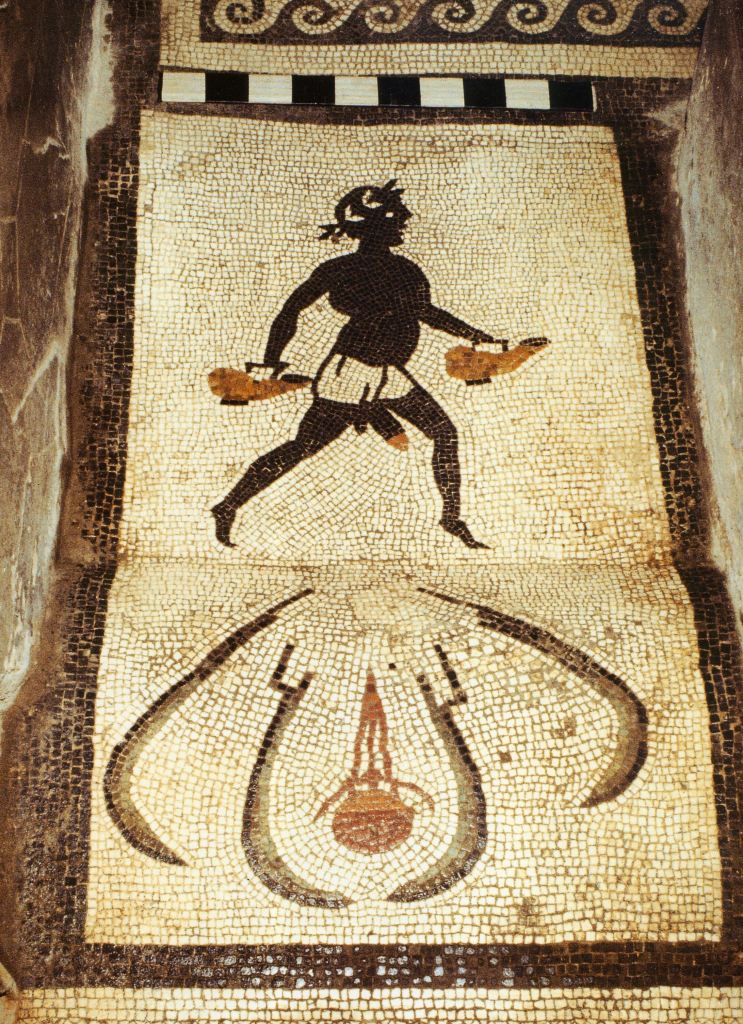
In the last part I examined the economics of fuel and water costs, also to understand the relationship between bath economics and the environment. With regard to costs, of particular importance was a recent article by DeLaine (2020) in which she analysed two innovative technologies of the time: glass windows and wall pipes. The analysis, which was also based on experimental archaeology, showed that these technologies could save up to 21% in resources.
Finally, from ancient sources and also according to Paolo Fedeli (1990), it was deduced that the Romans did not have environmental sensitivity as we moderns do. Their relationship with nature had to do with the sphere of the sacred and was experienced in a more visceral way; but this was not the case for everyone. In fact, there is no lack of evidence from the sources of those who deliberately exploited nature’s resources and those who saw no sacrilegious acts. In any case, it can be said that already at that time – obviously in a much less invasive way than today – human beings were in conflict with nature and caused damage to the ecosystem.
This study has attempted to analyse the social relations that took place within bathhouses in as much detail as possible, in order to gain a better understanding of Roman society and culture in general. This work is not a point of arrival, as is always the case, seeking answers to certain questions leads to new questions: there are still many problems to be understood and others to be discovered. For a very long time, we are actually talking about centuries, most scholars of the ancient world have concentrated on topics mainly concerning the political and military developments in the history of mankind—which historians are so passionate about—all of which are interesting and useful topics, but they have neglected topics related to microhistory but which in fact affected a large number of individuals more closely. I therefore hope that the topics of the social history of the ancient world will be increasingly deepened, because from the study of everyday life we will be able to gain a much more detailed picture of Roman society and culture. Knowing our past well will enable us to understand ourselves better.
Read the full dissertation here.
Deborah Crifó, Università di Bologna, Université Paris Cité
deborah.crifo@studio.unibo.it
https://unibo.academia.edu/DeborahCrifó
References
DeLaine, J. (2020), Strategies and Technologies of Environmental Manipulation in the Roman World. The Thermal Economy of Baths, in Schliephake C., Sojc N. & Weber G. (eds), Nachhaltigkeit in der Antike. Diskurse, Praktiken, Perspektiven, Stuttgart, 75-93.
Fagan, G.G. (1999), Bathing in Public in the Roman World, Ann Arbor.
Fedeli, P. (1990), La natura violata. Ecologia e mondo romano, Palermo.
Gentili, G.V. (1959), La villa Erculia di Piazza Armerina. I mosaici figurati, Rome.
Lanciani, R. (1923), Topografia Di Roma Antica: I Comentarii Di Frontino Intorno Le Acque E Gli Aquedotti, Rome.
Ward, R.B. (1992), Women in Roman Baths, Harvard Theological Review 85, 125-147.
To quote this page
Crifó D. (2024), The social and economic aspects of baths, between Rome and the provinces – thesis summary, consulted on INSERT DATE, <https://ancientbaths.com/2024/11/01/crifo-social-economic-aspects-of-baths/>
 BATH – BAlnea & THermae
Leave a comment