
The aim of this post is to introduce the recently started MSCA-Postdoctoral Fellowship project ‘Living With Art (LIVART) – Domestic Decorative Sculpture in the Western Roman Empire: reconstructing display, sociocultural dynamics, and addressing productive and economic processes’ (HORIZON-MSCA-2024-PF-01, no. 101207732). The project investigates the role of decorative sculpture in the private spaces of the Roman West, focusing on both urban domus and rural villae. Compared to public sculpture, which has been extensively studied, sculpture in domestic settings has received significantly less scholarly attention—despite being a key component in the visual and symbolic configuration of Roman homes.
These artworks were far from being mere decorations. They carried social, aesthetic, and cultural significance, reflecting the values, beliefs, and aspirations of their owners. LIVART seeks to understand how sculpture articulated daily experiences, identity discourses, power dynamics, and personal relationships within the private sphere.
A multidisciplinary and innovative methodology
LIVART adopts a transversal approach, combining archaeological analyses, iconographic and stylistic studies, archaeometric techniques (particularly marble provenance analysis), 3D documentation, and digital heritage technologies. The research covers a broad geographical area focused on the European provinces of the Western Roman Empire and spans chronologically from the Republican period to the end of the Empire.
The project is led by Dr Julio C. Ruiz at the University of Bonn (Germany), under the supervision of Prof. Stefan Feuser, and will run for 24 months. It also includes a secondment phase in three leading laboratories in Italy and Spain: the Laboratory of Ancient Materials Analysis (LAMA) at the Università Iuav di Venezia, the Stable Isotope Laboratory at the Institute of Environmental Geology and Geoengineering (IGAG) of the National Research Council in Rome, and the Department of Geology at the Autonomous University of Barcelona (UAB). These collaborations will ensure the effective integration of various scientific methods for the study of sculpture production (Fig. 1), particularly useful to reconstruct the economic dynamics associated with the sourcing and circulation of stone materials.
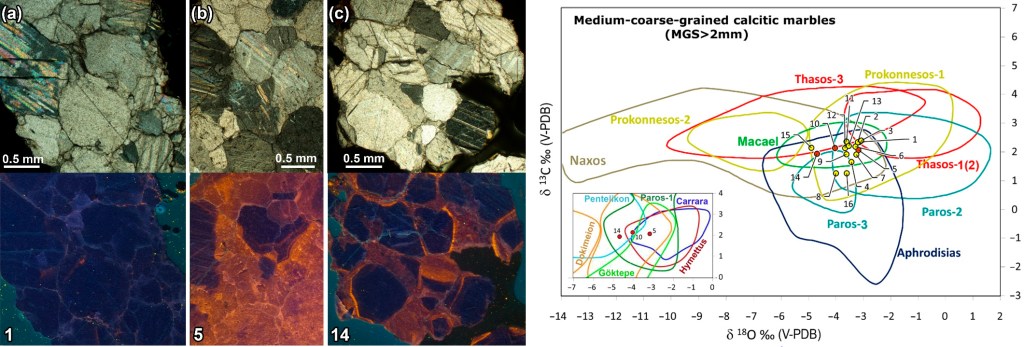
Left: Photomicrographs under a petrographic microscope (top) and cathodoluminescence images (bottom) of three marble samples taken from Roman sculptures.
Right: Scatter plot showing stable isotope values (δ¹³C and δ¹⁸O) from 16 marble samples taken from Roman sculptures.
(source: Casas et al. 2022, figs 2 and 3).
Sculpture and bathing culture: art in domestic balnea
One of the most fascinating aspects of the project is its focus on decorative sculpture in domestic balnea, the private bath complexes of Roman aristocratic residences. These spaces of hygiene, relaxation, socialisation, and representation could rival public bathhouses in architectural and symbolic complexity, and often shared similar decorative solutions.
In these environments, sculpture fulfilled aesthetic and symbolic functions related to physical care, health, and pleasure. Statues of deities such as Venus, Apollo, Aesculapius, and Salus evoked notions of beauty, physical care, and well-being, while fountains and waterspouts introduced a key sensory element into the bathing experience (Fig. 2).
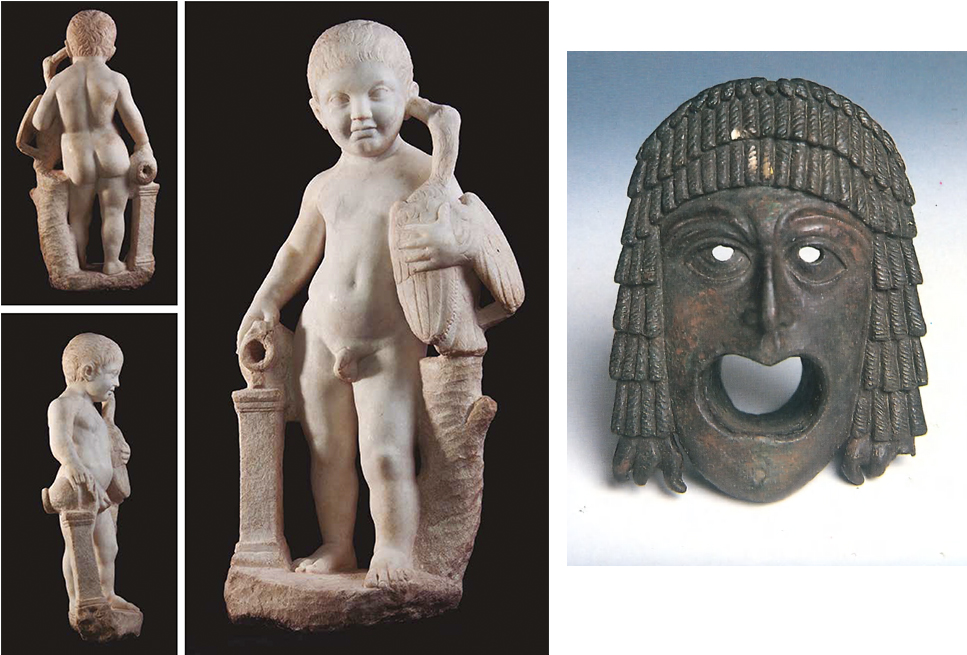
Left: Marble statue of a putto from the villa of Los Cantos (Murcia, Spain), with a waterspout emerging from a small vessel (photo: Noguera 2012, fig. on p. 279).
Right: Bronze theatrical mask used as a waterspout, from the balneum of the villa of Torreáguila (Badajoz, Spain) (photo: Almagro-Gorbea & Álvarez 1998, fig. on p. 337).
Among the most common motifs were figures associated with Bacchus’ entourage, aquatic deities like nymphs, river personifications (of Oceanus himself), and playful putti, all harmonising with the recreational nature of the bath. These sculptures often functioned as waterspouts, being hollowed to accommodate a lead pipe system that ended in a spout, cleverly integrated into a jug, a shell, or another appropriate part of the statue. Many spouts also took the form of masks—whether theatrical or animal, such as lions—combining hydraulic function with strong visual impact. Although such fountain-statues could also be found in other parts of the house, especially in gardens, they were particularly suited to the balnea due to their evident connection with water.
By studying these ensembles, LIVART offers new perspectives on how art shaped the experience of private bathing, revealing aesthetic sensibilities, consumption habits, and self-representation strategies among the Roman elite.
Bridging research and society
Beyond its academic dimension, LIVART is committed to open science, inter-institutional collaboration, and knowledge dissemination. Through partnership with museums, digital content creation, outreach activities, and a strong online presence, the project aims to open up the Roman domestic sphere to a broad audience interested in cultural heritage.
Follow us for updates on the project’s progress, sculpture analyses, material studies, and much more:
📌 Twitter/X: @LivartMSCA
📌 Instagram: @livartmsca
📌 Facebook: Living with Art
Additionally, you can learn more about LIVART on its official page at CORDIS, the European Commission’s research portal: https://cordis.europa.eu/project/id/101207732
Julio C. Ruiz, University of Bonn
jcruiz@uni-bonn.de
https://www.iak.uni-bonn.de/de/institut/abteilungen/klassische-archaeologie/personen/rodriguez
References
Almagro-Gorbea M. & J.M. Álvarez (eds.) (1998), En el año de Trajano. Hispania, el legado de Roma. La Lonja – Zaragoza, septiembre – noviembre de 1998, Zaragoza.
Casas Ll., R. di Febo, J.C. Ruiz, M. Brilli, F. Antonelli & J.D. Martín (2022), Archaeometric Classification of Scattered Marble Fragments to Help the Reconstruction of Statues, Minerals MDPI 12, e1614. https://doi.org/10.3390/min12121614
Noguera J.M. (ed.) (2019), Villae. Vida y producción rural en el sureste de Hispania. Museo Arqueológico de Murcia. 8 de marzo / 3 de junio, Murcia.
To quote this page
Ruiz J.C. (2025), New Project: Living with Art (LIVART) – Decorative Sculpture in Roman Domestic Spaces and its Presence in Private Balnea, consulted on INSERT DATE, <https://ancientbaths.com/2025/05/25/ruiz-living-with-art-livart/>
 BATH – BAlnea & THermae
Leave a comment