
by Marta Galindo Diaz
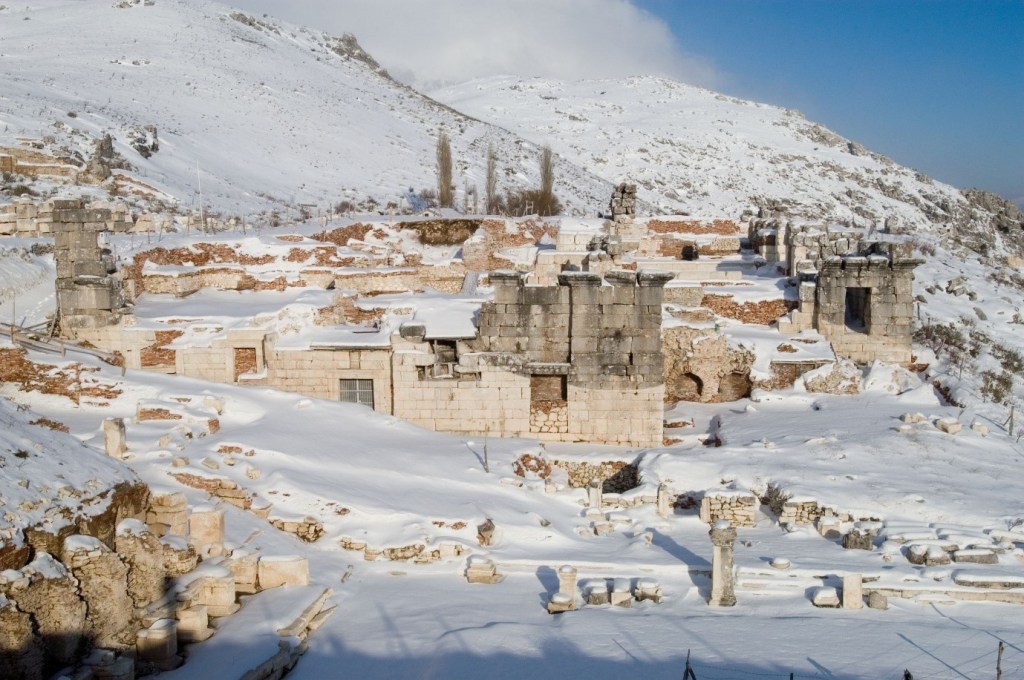
As part of my PhD research within the Sagalassos Archaeological Research Project, I am investigating the impacts associated to the multifaceted socio-economic activities of the daily life in Sagalassos during the Early Roman period. One particular focus of this study is the Bath-Gymnasium complex, which played a central role in the urban and social life of the city.
One aspect of our research considers the baths’ operation, in particular the high demand for firewood, primarily used for heating the bathing spaces. To better understand this aspect, we have developed a Building Energy Simulation (BES) model—a tool typically used in civil engineering—to estimate the energy required to heat the central caldarium of the Sagalassos Bath-Gymnasium. Our model currently provides overall estimates of wood consumption under a range of assumptions concerning building parameters, such as the composition and thickness of walls, the structure of the suspensura floor, and several other architectural features (as detailed in the accompanying table).
We are now taking the next step by assessing the uncertainty of these estimates and conducting a sensitivity analysis to identify which architectural and material parameters most strongly influence energy consumption. To achieve realistic results, we need to compile reliable comparative data from other Roman bath buildings. This is where your expertise would be invaluable. If you have information or measurements from bath complexes you have studied, particularly concerning wall thicknesses, construction materials, hypocaust floor dimensions, or related architectural details, your input could make a significant contribution. By filling in the attached table with data from your site(s), you will help us refine our model and reduce the need for time-intensive plan analyses across multiple examples.
An Excel file is provided for those who wish to contribute. The different columns of the file are explained below. The values shown are only estimates and do not reflect the actual situation at Sagalassos; they are included merely to give the reader a basis for comparison.
| Name of the column | Explication and Example | Additional information |
| Researcher email address | Your email address | |
| Name of the bath building | Name of the baths, e.g., Sagalassos Bath-Gymnasium | |
| Link to Google Maps location | ||
| Caldarium name and dimensions | E.g., C1 (4*4*6 m), C2 (5*4*6 m) Create at least 1 entry per room | Include the dimensions (width, length, and height) |
| Exterior wall | North, West, South, or East Create 1 entry per wall | Only exterior walls! If the caldarium is surrounded by other rooms, or if a wall is shared with another room, it should not be included here. Only include walls that face the exterior. |
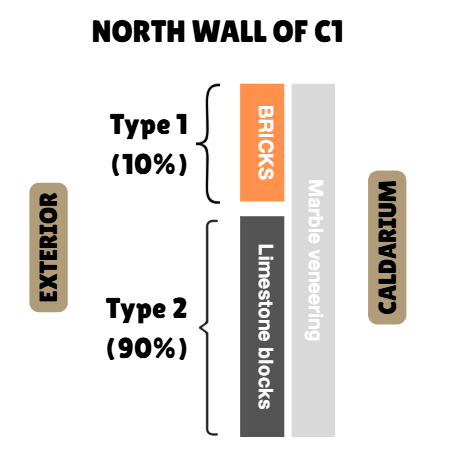
| Construction materials, thickness, and % of total exterior wall | Type 1 (10%): Brick (2 m thick) => Marble veneer (0.1 m) Type 2 (80%): Limestone blocks (2 m) => marble veneer (0.1 m) Type 3 (10%): Brick facing (1 m thick) => concrete (1 m thick) => marble veneer (0.1 m) Create 1 entry per type of wall | A wall can be made of two or more different materials; in that case, list the materials in sequence from the exterior to the interior (see diagram below). If a wall includes two different sequences of materials, each sequence must be entered separately as an additional record in the database (type 1, type 2…). Brick and bonding mortar combinations can be simplified to just brick. However, structural mortar used in concrete constructions must be included. If the concrete core is faced with bricks, that brick layer should also be included. |
| Heated walls | North, South, East, or West Create 1 entry per wall | Only the walls that present heating elements such as tubuli or tegulae mammatae. |
| Type of wall heating system and available volume for hot air to flow | e.g., tegulae mammatae (a 50 cm space between the tile and the wall, wall is 2 m high and 4 m wide → total volume: 4 m³) | If heated walls are different from tubuli or tegulae mammatae, specify the configuration. |
| Construction materials and thickness of heated walls | Terracotta tiles (0.4 m) | Normally, heated walls consist of the same sequence of building materials throughout. However, if this varies, the same approach used in the column “Construction, materials, thickness, and % of total exterior wall” should be applied. We are not interested in the back wall, only if this is an exterior wall and then it must be indicated in the previous columns. |
| Construction materials and thickness of suspensura | Bricks (0.1 m) => Concrete (0.14 m) => Marble veneer (0.1 m) | The sequence of elements in this case must be indicated from the hypocaust side to the caldarium side. Normally, the suspensura consists of the same sequence of building materials throughout. However, if this varies, the same approach used in the column “Construction, materials, thickness, and % of total exterior wall” should be applied. |
| Hypocaust: name and dimensions | HC1(4*4*0.6 m) Create at least one per caldarium | Include dimensions (width, length, and height) Hypocaust naming rule: Use the caldarium name preceded by “H” Example: C1 → HC1; C2 → HC2 etc. |
| Ceiling Type | Vaulted ceiling | Describe the ceiling above the caldarium. Use categories such as vaulted, flat, or pitched roof. If the roof is of a different type from those mentioned here, indicate its configuration in the observation columns. |
| Construction materials and thickness of ceiling | Terracotta tiles (0.1 m) => Airspace (1 m) => Brick vault (1 m) | The sequence must be put from the exterior facing to the interior. |
| References | ||
| Observations | Indicate any details you consider relevant for describing the building elements, such as a description of the roof or heating system, especially if they differ from the classifications provided above. |
Your collaboration would be greatly appreciated, and all contributors will, of course, be duly acknowledged in the resulting publication. Thank you very much for your time and for considering supporting this interdisciplinary effort to better understand the energetic realities of Roman urban life. If you have any question or want to collaborate, please send an email to: marta.galindodiaz@kuleuven.be
Marta Galindo Diaz, KU Leuven
marta.galindodiaz@kuleuven.be
https://orcid.org/0009-0004-5474-0677
 BATH – BAlnea & THermae
Leave a comment