
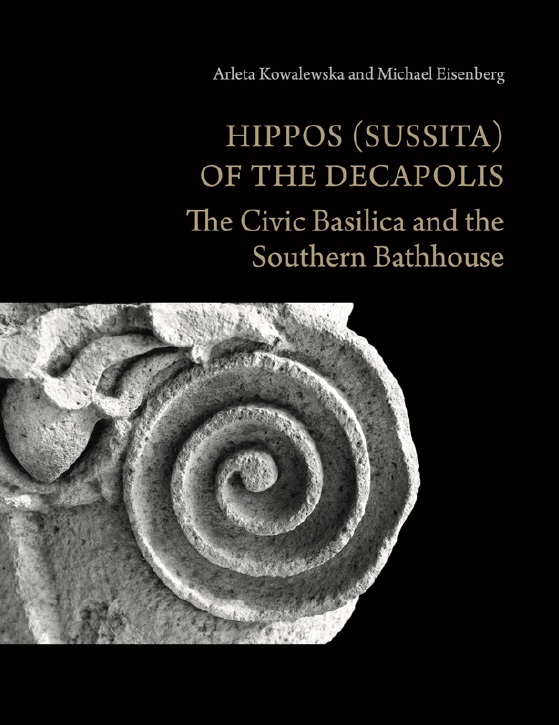
Dr Arleta Kowalewska, a research fellow at the Zinman Institute of Archaeology of the University of Haifa and a founding member of the BATH Network, and Dr Michael Eisenberg, a senior lecturer at the School of Archaeology and Maritime Cultures of the University of Haifa and a long-standing dig director of the Hippos Excavations Project, have just published a final report from the excavations of the Southern Bathhouse at Hippos (Sussita) of the Decapolis, as well as the Roman-period civic basilica of Hippos. The stratigraphic part is accompanied by 11 chapters contributed by various experts that publish many types of finds. The monograph released by Eisenbrauns/Penn State University Press is for now available for purchase in hardcover and soon to be available also in e-book version, with 30% off using code ND26. Acquisition of an electronic version is advised to fully make use of many links to supplementary online material (like this photogrammetric model of the Southern Bathhouse at the end of the excavations).
Antiochia Hippos (Sussita in Aramaic) is situated upon a hill ca. 2 km east of the Sea of Galilee, within the Hippos (Sussita) National Park, in modern Israel. Established by the Seleucids in the 2nd century BCE, it flourished in the Roman period as part of the Decapolis, a group of Graeco-Roman cities among Semitic peoples, inside Provincia Syria. The Southern Bathhouse was built upon the firm foundations of earlier fortifications in the 2nd century CE, restructured in the middle of the 3rd century CE, and abandoned toward the mid-4th century CE. Circa 65% of the 1,050 m2 expected area of the bathing complex has been exposed, revealing four heated halls, one unheated hall with a pool, and three stoke rooms. It was constructed with the same materials (including ceramic building materials) and methods as other regional, public, urban bathhouses, and is especially similar to other cities of the Decapolis and the one other public bathhouse known from Hippos. The Southern Bathhouse is one of the best studied bathhouses within the region, with the full publication not only of its architecture but also its portable finds. Particularly notable among these finds is the assemblage of over 30 bone dice and some 170 coins that were recovered from the bathhouse’s drain. The Southern Bathhouse also produced one of the largest collections of marble and decorative limestone from Hippos to date. These finds are mainly fragments of slabs that decorated the floors and walls of the bathing halls. The other marble finds are fragments of statues, three of which came from the bathhouse fills.
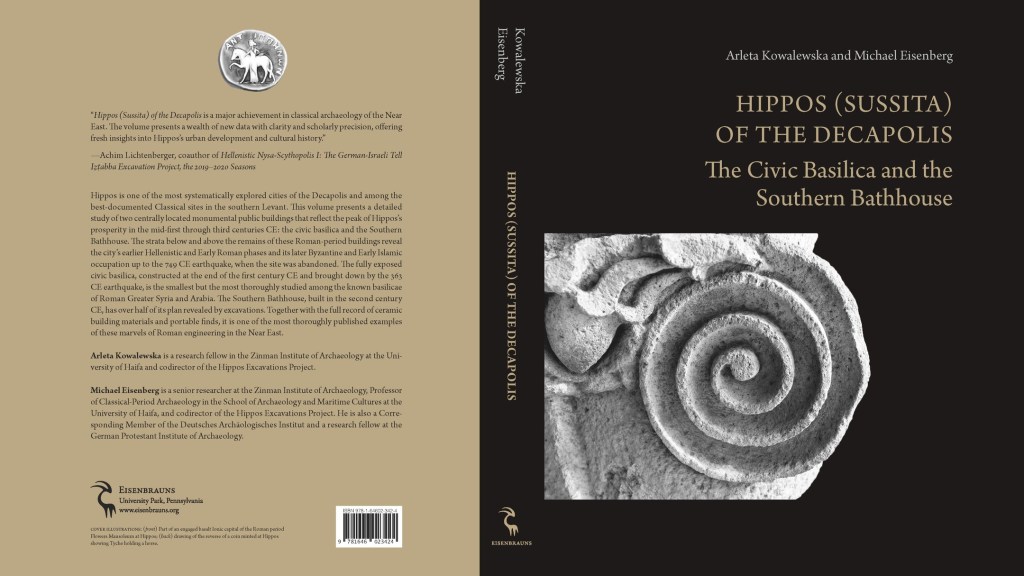
Table of contents:
1 Introduction
Arleta Kowalewska and Michael Eisenberg
2 The Civic Basilica of Hippos
Michael Eisenberg
3 The Southern Bathhouse of Hippos
Arleta Kowalewska
4 Pottery Finds 2012–2016 at Hippos: Basilica and Southern Bathhouse
Peretz Reuven and Arleta Kowalewska
5 Pottery Finds 2017–2018 at Hippos: Southern Bathhouse
Vladimir Lehem
6 Ceramic Building Materials at Hippos: Hypocaustum of the Southern Bathhouse and Civic Basilica Roof Tiles
Arleta Kowalewska
7 Marble Architectural Fragments of the Roman Basilica at Hippos
Antonio Dell’Acqua
8 Osteological Study of the Skeletal Remains Recovered from the Civic Basilica at Hippos
Ariana Dann and Hila May
9 An Aramaic Dipinto on a Sherd from Hippos
Ohad Abudraham and Michael Eisenberg
10 Coin Finds 2012–2018 and an Updated Conspectus of Coins found at Hippos
Danny Syon
11 Metal Finds from the Basilica and the Southern Bathhouse at Hippos
Nina Koskanen, Arleta Kowalewska, Alexander Iermolin, and Michael Eisenberg
12 Iron Nails from the Civic Basilica and the Southern Bathhouse at Hippos
Nina Koskanen
13 Glass from the Late Roman and the Late Byzantine–Early Islamic Dumps and Special Glass Finds from the Basilica and the Southern Bathhouse at Hippos
Ruth E. Jackson-Tal
14 Other Finds from the Basilica and the Southern Bathhouse at Hippos
Arleta Kowalewska and Michael Eisenberg
15 Summary
Michael Eisenberg and Arleta Kowalewska
Bibliography – Hippos and its Territory
 BATH – BAlnea & THermae
Leave a comment