
A Marie Skłodowska-Curie Global Postdoctoral Fellowship on Economic and Energy Sustainability of Late Antique Baths in the Mediterranean
On February 1st, BALNEa – Baths’ Architecture in Late Antique Sicily: Natural Resources and Economic Sustainability officially started. The project is funded under the Marie Skłodowska-Curie Postdoctoral Fellowships (Horizon Europe) and is hosted by the Department of History and Cultures at the University of Bologna (UNIBO), in collaboration with the Institute for Digital Exploration (IDEx) at the University of South Florida and, for the secondment phase, with the Energy Sustainability and Environmental Control Laboratory (SECA) at the University of Catania. It aims to reassess, within a systemic framework, the transformation and progressive decline of public baths between the 4th and 7th centuries CE, moving beyond monocausal interpretations and introducing an integrated analysis of economic, environmental, and energetic factors.
Roman baths were technologically complex and highly energy-intensive structures. Their operation required a continuous water supply, substantial quantities of fuel to power hypocaust heating systems, constant maintenance, and a structured organizational framework. BALNEa is grounded in the assumption that the sustainability of such buildings cannot be interpreted solely in cultural or religious terms; rather, it must be evaluated as a balance between natural resource availability, energy costs, logistical accessibility, and the economic capacity of local communities.
The core of the research focuses on approximately fifteen Late Antique bath complexes in Sicily, selected for their archaeological relevance and state of documentation. The analysis integrates architectural archaeology, three-dimensional digital survey, study of construction materials, and environmental building physics simulations tailored to ancient materials and paleoclimatic parameters. These simulations enable the reconstruction of plausible operational scenarios, estimating thermal dispersion, heating times, water consumption, and fuel demand in order to assess the managerial sustainability of the complexes across different phases of transformation.
The Sicilian case studies are examined within a broader comparative framework that includes contexts in Greece, the Italian Peninsula, and North Africa—regions that provide significant evidence of continuity, downsizing, or functional transformation of bath buildings in Late Antiquity. This Mediterranean-scale comparison allows the identification of recurring dynamics and helps distinguish local phenomena from wider structural trends, contributing to a more precise evaluation of the relative weight of environmental and economic variables alongside other interpretative factors.
BALNEa further expands the paradigm of Architectural Energetics by incorporating not only the estimation of the energy investment required for construction, but also the analysis of medium-term operational costs. Within this perspective, volumetric reduction, functional simplification, and the reuse of earlier structures—documented in numerous sites—can be interpreted as adaptive strategies responding to climatic shifts, resource contraction, and changing economic priorities.
The project will also develop an open-access digital catalogue including three-dimensional models and structured datasets in accordance with FAIR principles, promoting interoperability, methodological transparency, and replicability. By integrating archaeological and engineering expertise, BALNEa seeks to provide both a methodological and interpretative contribution to the study of public architecture and its transformations in the Late Antique Mediterranean.
The Principal Investigator – MSCA Research Fellow
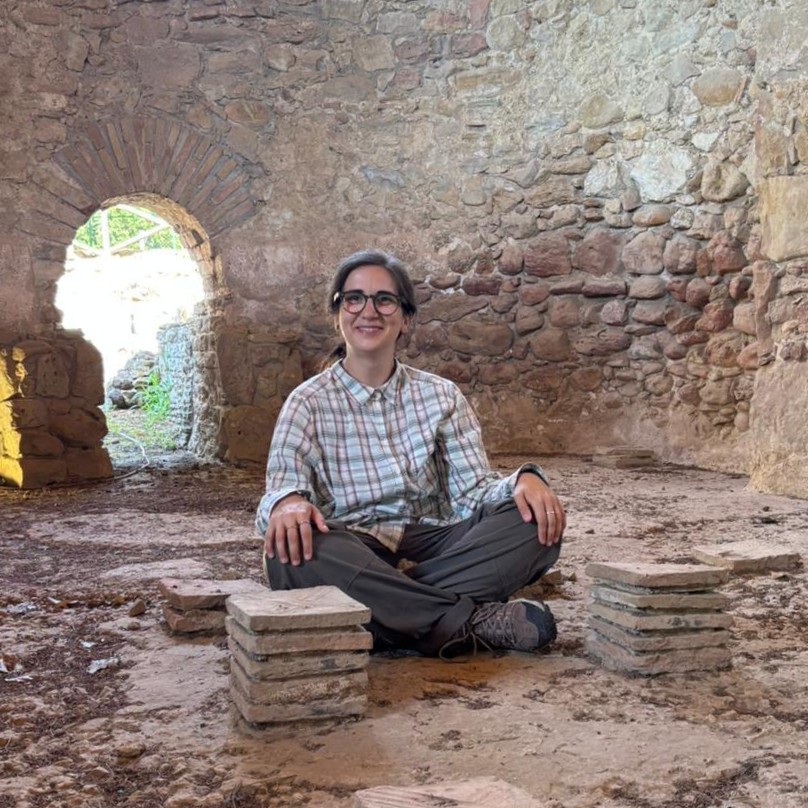
The project is led by Claudia Lamanna, MSCA Research Fellow at the University of Bologna. She holds a Master’s degree in Architecture and a postgraduate diploma in Architectural and Landscape Heritage from the Polytechnic of Bari. In 2023, she completed her PhD in Christian and Medieval Archaeology at the University of Bologna (Department of Cultural Heritage), with a dissertation dedicated to public thermal bath complexes in Late Antique Greece, soon to be published.
Her research focuses on public architecture in the Roman and Late Antique periods, with particular attention to civic and religious buildings and to the diachronic development of urban contexts in Italy and Greece. She has worked on numerous archaeological sites in Italy, Greece, and Tunisia, combining stratigraphic and architectural analysis with technical drawing of structural remains, both in situ and as excavated fragments, often employed in the development of digital reconstructions.
Her main field of expertise concerns the history and restoration of ancient architecture. She is currently involved in research projects on thermal complexes and ecclesiastical architecture in Italy and the Hellenic Islands, as well as on a site in Tunisia, strengthening the Mediterranean perspective that underpins BALNEa.
Follow us for updates on the project’s progress, sculpture analyses, material studies, and much more:
Instagram: @balnea_project
Web site: https://site.unibo.it/balnea-baths-architecture-in-late-antique-sicily
Additionally, you can learn more about BALNEa on its official page at CORDIS, the European Commission’s research portal: https://cordis.europa.eu/project/id/101198323
Claudia Lamanna, University of Bologna
https://orcid.org/0000-0003-2464-3003
 BATH – BAlnea & THermae
Leave a comment