
Brick
Ceramic building element used mainly for structural supporting elements (e.g. walls, pilae, or suspensura) of construction, as opposed to tile. The Roman bricks commonly used in baths tend to be thinner and larger than modern bricks. Three common modules are the bessales, sesquipedales, and bipedales.
Bessalis
Pl.: bessales
Square bricks measuring ⅔ of a Roman foot, or c. 20 cm. They are commonly used in the hypocausts of baths for the construction of the pilae.
Sesquipedalis
Pl.: Sesquipedales
Bricks measuring one and a half Roman feet (c. 44.4 cm) and often used in the construction of bathhouses.
Bipedalis
Pl.: bipedales
Large square ceramic bricks measuring two Roman feet, or c. 59.2 cm. In baths, they were often used to span the gap between the hypocaust pillars (pilae), so the distance between two pillars was restricted to circa 60 cm centre-to-centre.
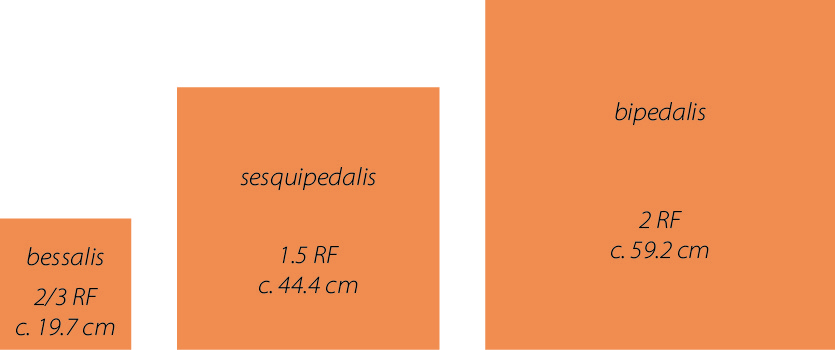
Dimensions of the brick modules most commonly used in Roman baths.
 BATH – BAlnea & THermae