
by Isabel Aguilar Corona
This paper summarizes some of the results obtained in my doctoral research project “Aqva Aruccitana: The bath building and water management in the city of Arucci”. Although the study addresses water management and use in the Roman city in general terms, its analysis naturally leads to one of the spaces where its presence is most significant: the baths. This building is one of the best examples of the interdependence between hydraulic infrastructure, architecture, and social life within the Roman urban landscape.
In this context, the Roman city of Arucci stood in the heart of what is now the Sierra de Aracena and Picos de Aroche (Huelva, Spain). Its strategic location between the Guadalquivir valley, the Portuguese Alentejo and the Andévalo region of Huelva made it an important hub for economic and cultural exchange. Founded under the auspices of Augustus, Arucci flourished during the Julio-Claudian and Flavian dynasties, reaching the peak of its urban development during this period. Despite its small size (barely 8 hectares), the city boasted the main features of Roman urban planning: a forum complex, a market, a necropolis, a pottery district, an aqueduct and more than twenty houses.
Within this urban fabric lies the bath building, the layout of which is not yet fully known (only around 1,400 m² has been excavated so far), although the preserved evidence allows us to partially reconstruct its architectural development and put forward hypotheses regarding its function.
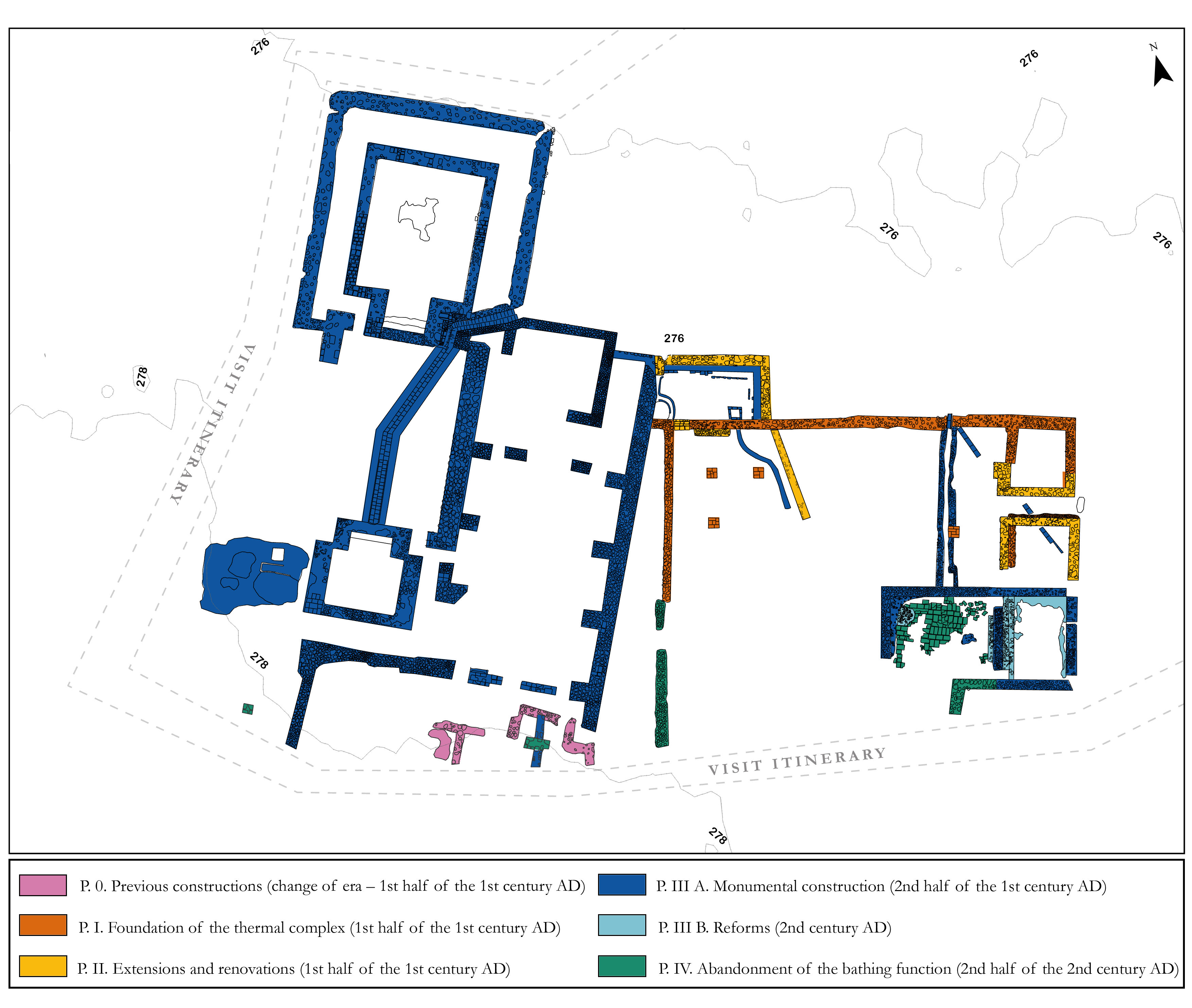
Although the earliest traces date back to the turn of the 1st century AD, they still correspond to relatively previous structures. The final configuration of the complex began in Phase I, when the plot layout was reorganised and a porticoed public space was defined. Following several alterations during the first half of the 1st century AD (Phase II), the building reached its peak during the Flavian period, when the complex acquired a more monumental character and the hydraulic system regulating the water cycle was completed (Phases III A and B). The decline began in the early 3rd century AD, with the gradual loss of the baths’ function and the repurposing of various spaces (Phase IV). Finally, the building was abandoned and systematically looted, before its ruins were occupied on a residual basis (Phase V).
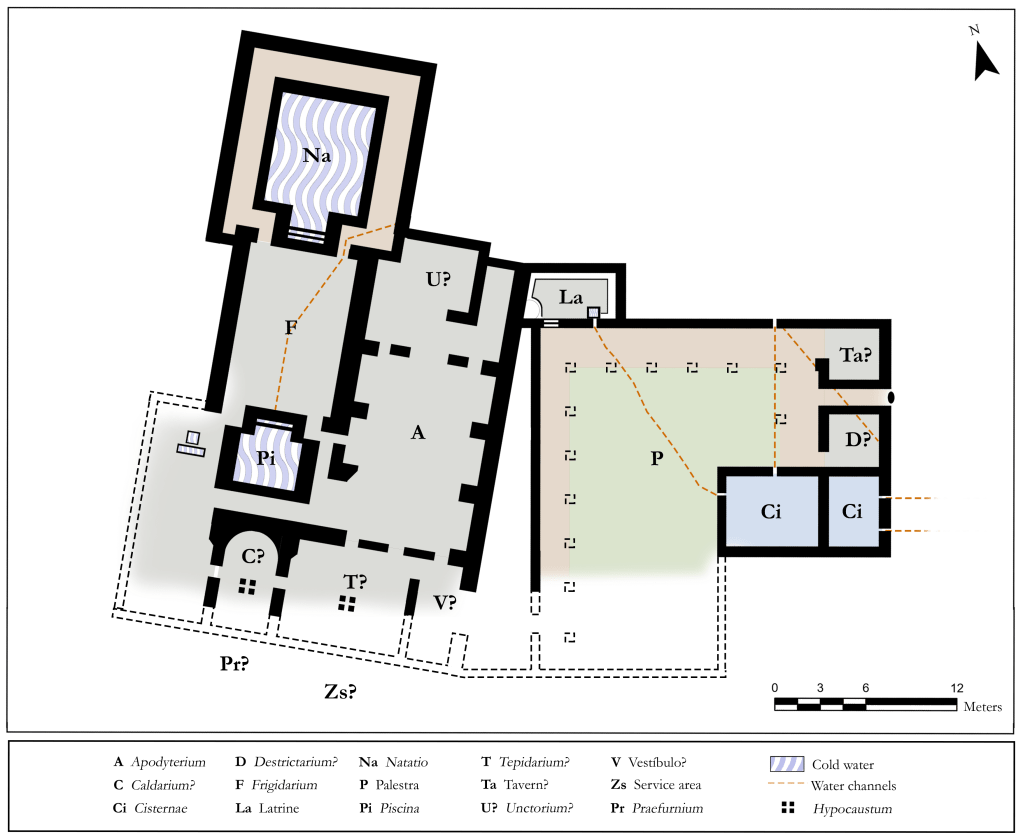
Based on architectural analysis and a typological comparison with other bath complexes, it has been possible to formulate a well-founded hypothesis regarding the spatial organization of the bath building (Fig. 2). On this interpretative basis, the functioning of the complex can be addressed in a coherent manner, providing insight into both the functional sequence of its spaces and its integration within the city’s urban landscape.
Access to the bath complex would have been via a road situated at the rear of the forum, integrated into the city’s main urban fabric. From this point, there was direct access to the palaestra, a large porticoed space intended for physical activity and socializing, which would have served as one of the building’s main gathering areas.
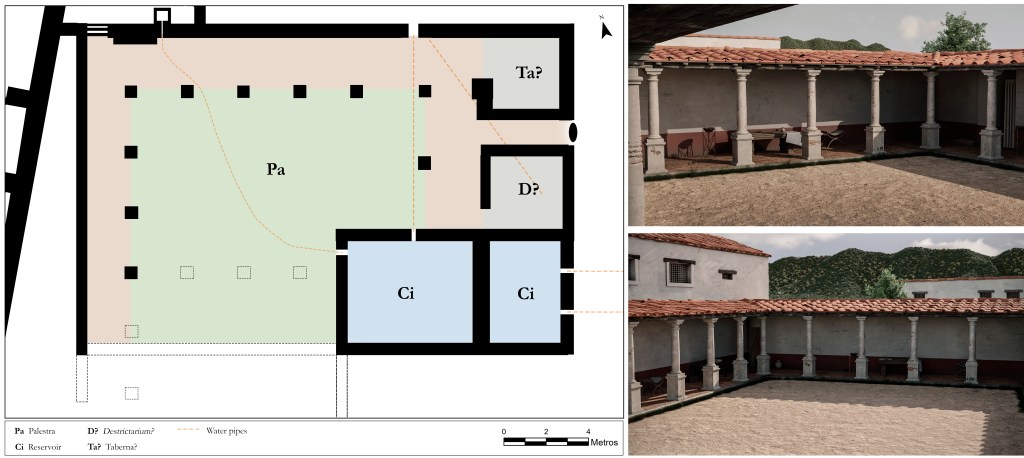
The entrance would lead into a small vestibule or corridor from which access to the various areas of the complex was organized. On either side of this corridor are two small rooms whose purpose remains unclear (Fig. 3). The lack of conclusive material evidence prevents a precise definition of their use, although comparison with other bath complexes suggests that they may have functioned as auxiliary spaces linked to physical exercise and personal care, such as rooms for massages or for washing the body after exercise (Nielsen 1990: 165).
The exact layout of the palaestra still presents some uncertainties due to the alterations suffered by the area and the partial excavation of the building. However, the preservation of several brick pillars allows us to conclude that at least three of its sides were porticoed (Fig. 3).
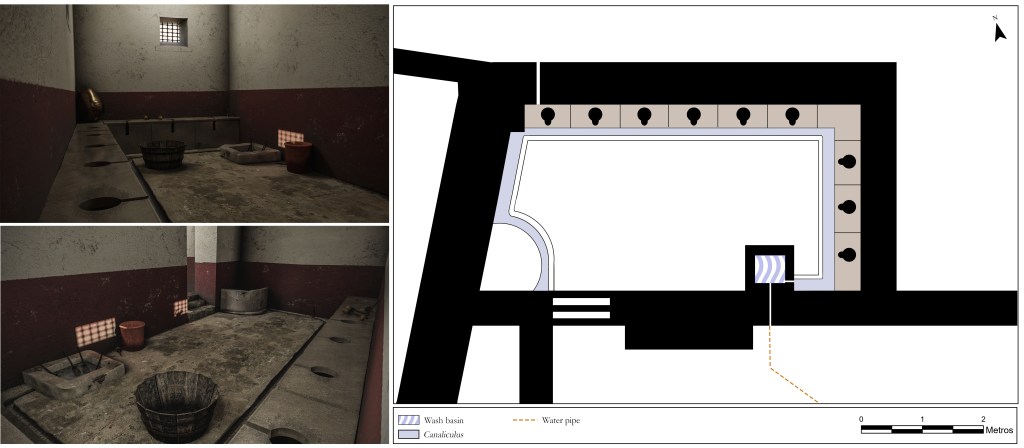
The latrine is situated directly adjacent to the palaestra, forming a rectangular room covering approximately 13 m² (Neudecker 1994: 154–155). The proper functioning of the latrines was ensured by a drainage channel running along two of the walls enclosing the space (NE), a feature which, together with the preserved foundations of the continuous bench, suggests that the seats were arranged in an inverted ‘L’ shape. In the absence of structural remains, it is not possible to determine exactly how many users the room could accommodate. However, taking the dimensions of the drainage channel as a reference and applying the average number of seats documented in other latrines with similar morphology and dimensions (taking as an example the evacuation holes of the public latrine of the via della Forica in Ostia Antica: 0.55 m and 0.15 m in diam.), it can be hypothesised that the bench had the capacity for approximately nine people at the same time (Fig. 4).
The connection between the palaestra and the strictly bathing area is complex, as both sections have different orientations and dimensions. The route into the building would have been via an intermediate room which, although not formally a conventional corridor or passageway, would have functioned as a transitional space designed to organize users’ access to the bathing areas.
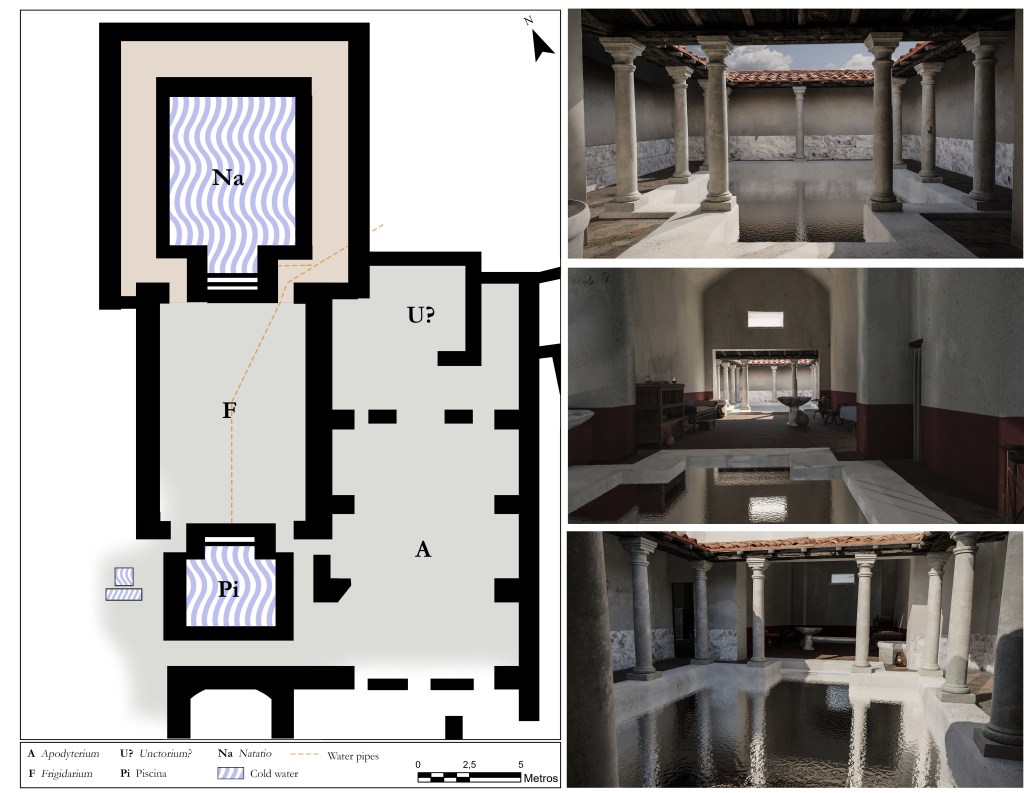
From this space, one enters a large room measuring approximately 135 m², which, due to its central location within the complex, as well as its layout and connection to the other rooms, has been identified as the apodyterium or changing room (Fig. 5).
Once past the apodyterium, the thermal circuit led into the cold section of the building, clearly marked by the presence of two bathing pools: an open-air natatio and an indoor piscina. Both are situated within a rectangular room measuring approximately 300 m², which morphologically corresponds to the classic type of frigidarium described in the specialist literature (Nielsen 1990: 153–154): a spacious room with an elongated floor plan, covered (at least partially) by a vault, and featuring large windows to ensure adequate natural light.
From this point onwards, the interpretation of the various rooms must necessarily be approached from a hypothetical perspective, given the incomplete nature of the excavation and the absence of clearly defined structures in some parts of the building.
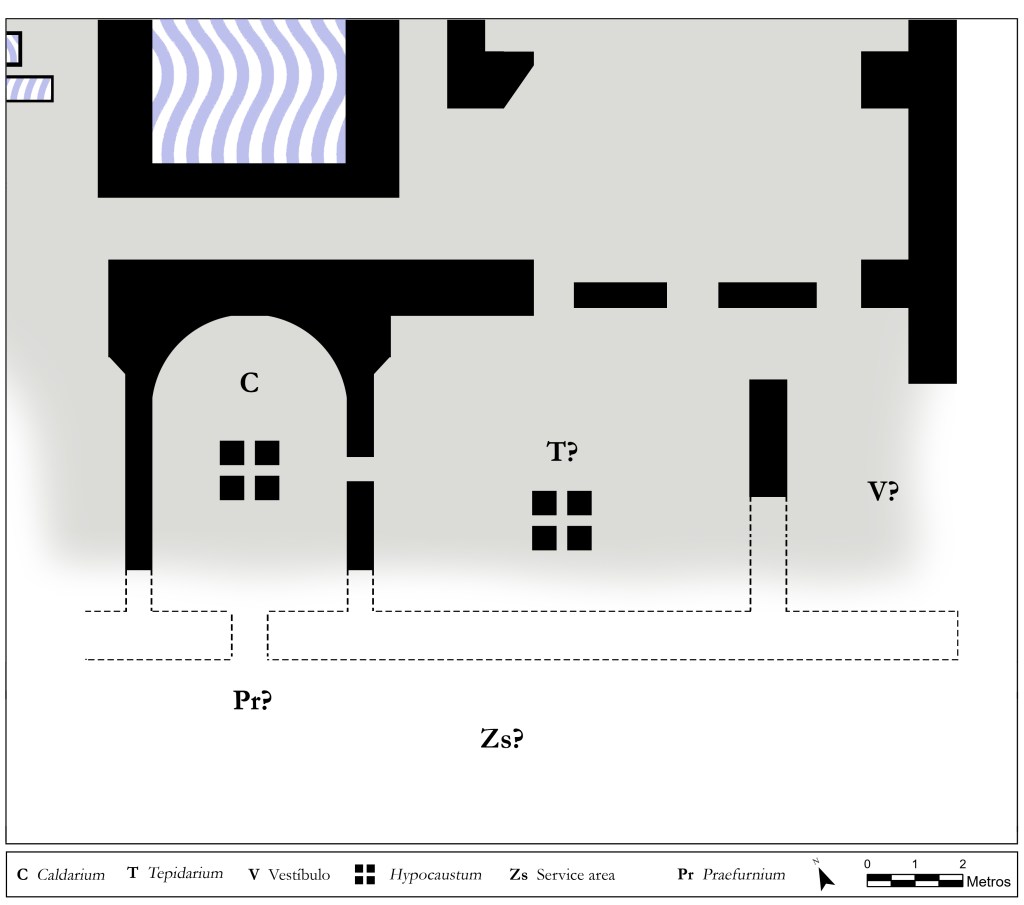
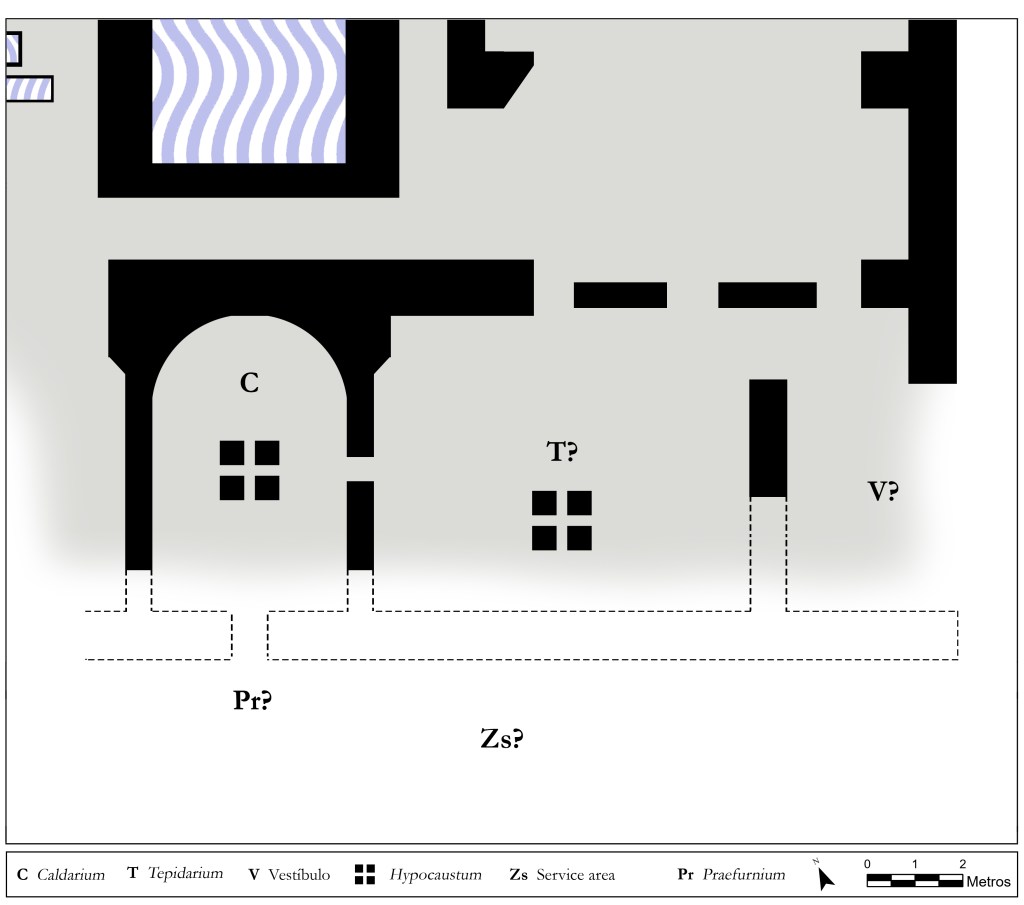
The exact location of the tepidarium has not been definitively established. However, we propose situating it on the eastern side of the caldarium, following a layout common to many Roman bath complexes, where the two rooms are arranged side by side to maximise the use of heat (Fig. 6). The layout of both rooms may have resembled that documented in the double baths at Mura, where the tepidarium and caldarium are situated adjacent to one another and on the same axis.
Something similar applies to the caldarium. Although this room has not been fully excavated and does not retain any unambiguous wall structures, there are various architectural and material clues that allow us to identify it (several ceramic fragments associated with concamerationes have been identified within the assemblage, including pieces comparable to type 1b defined by Sanz Gamo (1987); similar materials have been documented in other bath complexes across Hispania, although usually as dispersed finds not preserved in situ). The room would have been located in the southern part of the building, in accordance with the principles described by Vitruvius (De Arch. V, 10, 1), who recommended placing heated rooms in the areas most exposed to solar radiation. Furthermore, it features an apse-like or semi-circular plan at one end, a common layout for this type of space, typically associated with alvei or labra used for water.
Having established the building’s spatial layout, we can now examine the internal layout of the bath complex.
Classifying the building as a specific type is difficult due to the incomplete nature of its floor plan. However, the preserved spaces and the identified functional sequence allow us to propose a linear layout, with the main bathing areas arranged along a single axis.
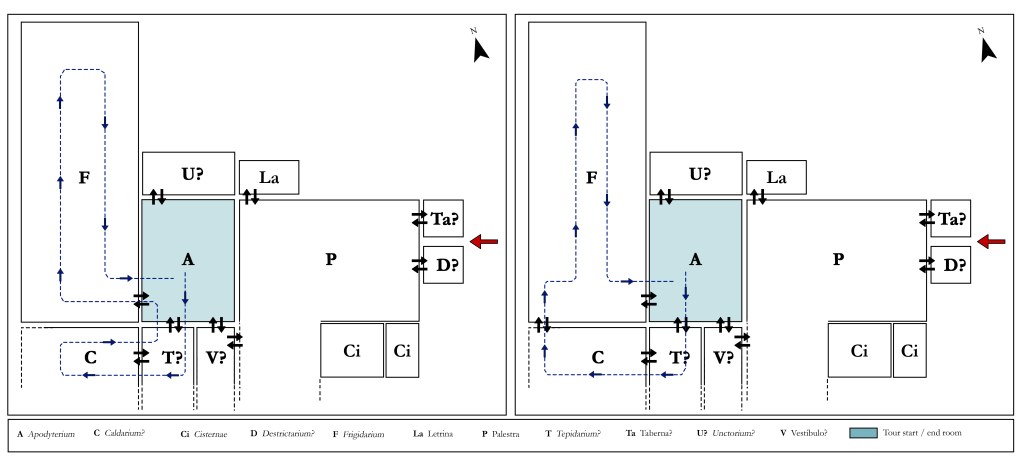
If we consider only the rooms linked to the thermal circuit, two interpretative hypotheses can be proposed within a linear layout (Fig. 7).
The first would correspond to a linear-angular layout. In this case, the layout of the spaces suggests an inverted ‘L’ shape, with a reverse-flow circuit: bathers would begin their circuit in the apodyterium, with access to both the frigidarium and the tepidarium, continue on to the caldarium, and then return to the frigidarium before ending at the cold pool. This layout involves retracing one’s steps, a characteristic feature of this type of spatial organisation.
The second hypothesis would fit a linear axial model. Its feasibility requires the existence of a direct passage between the caldarium and the frigidarium via the western section, which is currently undocumented due to the incomplete state of the excavation. If this connection were confirmed, the route could be followed continuously without the need to backtrack, creating a more fluid circuit that is potentially comparable to other, larger, bath complexes.
Isabel Aguilar Corona, Huelva University
isabel.aguilar@dhga.uhu.es
https://orcid.org/0000-0003-2082-1300
References
Degbmont, J. M. (1984), Hypocaustes. Le chaufage par hypocause dans l’habitat privé, Eraul 17, Lieja.
Delaine, J. y Johnston, J. (1999), Roman Baths and Bathing, Proceedings of the 1st International Conference on Roman Baths (Bath, 30 March – 4 April 1992), JRA Suppl. Series 37.
Fagan, G. G. (1999), Bathing in Public in the Roman World, Michigan.
Fernández Ochoa, C., Morillo Cerdán, Á. y Zarzalejos Prieto, M.(1999), “Material latericio en las termas romanas de Hispania”, Actas de la Table Ronde La Brique et ses dérivés à Vépoque romaine. Production, utilisation et difusión dans les provincias Occidentales (Hispanic, Gaule et Italie), Madrid, 291-306.
Koloski-Ostrow, O. (2015), The archaeology of sanitation in Roman Italy. Toilets, sewers, and water systems, University of North Carolina Press.
Maréchal, S. (2020), Public baths and bathing habits in late antiquity: a study of the evidence from Italy, North Africa and Palestine between AD 285-700, Late Antique Archaeology Vol. 6. Leiden, Boston, Brill.
Neudecker, R. (1994), Die Pracht der latrine. Zum Wandel öffentlicher Bedürfnisanstalten in der Kaiserzeitlichen Stadt.
Nielsen, I. (1985), “Considerazioni sulle primer fasi dell’evoluzione dell’edificio termale romano”, Analecta Romana, XIII, 81-112.
Nielsen, I. (1990), Thermae et Balnea. The Architecture and Cultural History of Roman Public Baths, Aarhus.
Noguera Celdrán, J. M., García-Entero, V. y Pavía Page, M. (2020), Termas públicas de Hispania. Actas del Congreso Internacional Termas Públicas de Hispania (Museo Arqueológico de Murcia-Museo del Teatro Romano de Cartagena, 19-21 de abril de 2018), SPAL Monografías Arqueología, 33, Universidad de Sevilla, Universidad de Murcia.
Sanz Gamo, R. (1987), “Materiales cerámicos utilizados en la construcción de hypocaustos en el Sureste peninsular: clavijas y ladrillos recortados”, Crónica del XIX Congreso Arqueológico Nacional, Vol. 1, 877-884.
Yegül, F. (1992), Baths and Bathing in Classical Antiquity, The MIT Press.
Yegül, F. (2010), Bathing in the Roman World, Cambridge University Press.
To quote this page
Aguilar Corona, I. (2026), Aqva Aruccitana: The bath building and water management in the city of Arucci – thesis summary, https://ancientbaths.com/2026/06/17/thesis-summary-aqva-aruccitana-the-bath-building-and-water-management-in-the-city-of-arucci/
 BATH – BAlnea & THermae
Leave a comment